Every learnergets a different test.
Questions drafted from your own coursework, difficulty that moves with every answer, and a report of what a learner can actually do.
Enterprise · Government · Higher education · K-12
A fixed test measures the room. It was never aimed at the learner.
One size, one pace
A fixed form cannot adjust to a learner's context, pace or prior knowledge. It asks the same thing of everyone and calls the spread a result.
Half the room checks out
Pitch an item at the middle and it is trivial for one group and impossible for another. Neither learns anything from answering it.
Narrow by design
Higher-order thinking, applied skill and progress over a term are the things institutions care about, and the things a static test measures worst.
Inherited bias
Hand-written items carry linguistic, cultural and contextual load. It distorts the score without ever announcing itself.
The workload
Writing, administering and scoring assessments consumes the hours that were supposed to go into teaching.
One platform, three views.
A university problem set, a school office, a support team’s compliance training — one engine, three sectors, three seats.
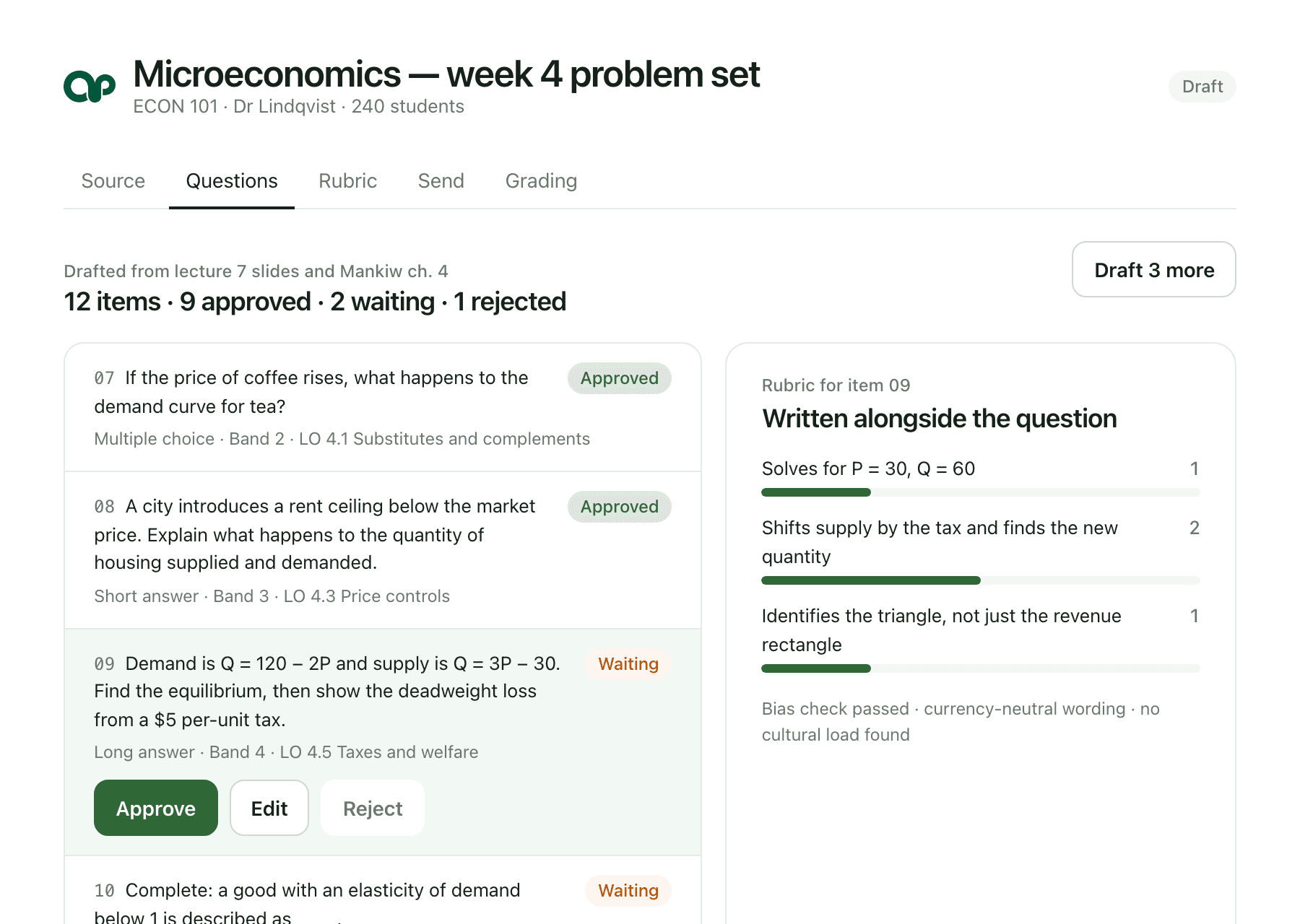
For faculty
Approve each item before a student sees it.
Items are drafted from the week's lecture and reading, banded by difficulty and tied to a learning outcome. The rubric is written beside the question, not invented afterwards.
For the school office
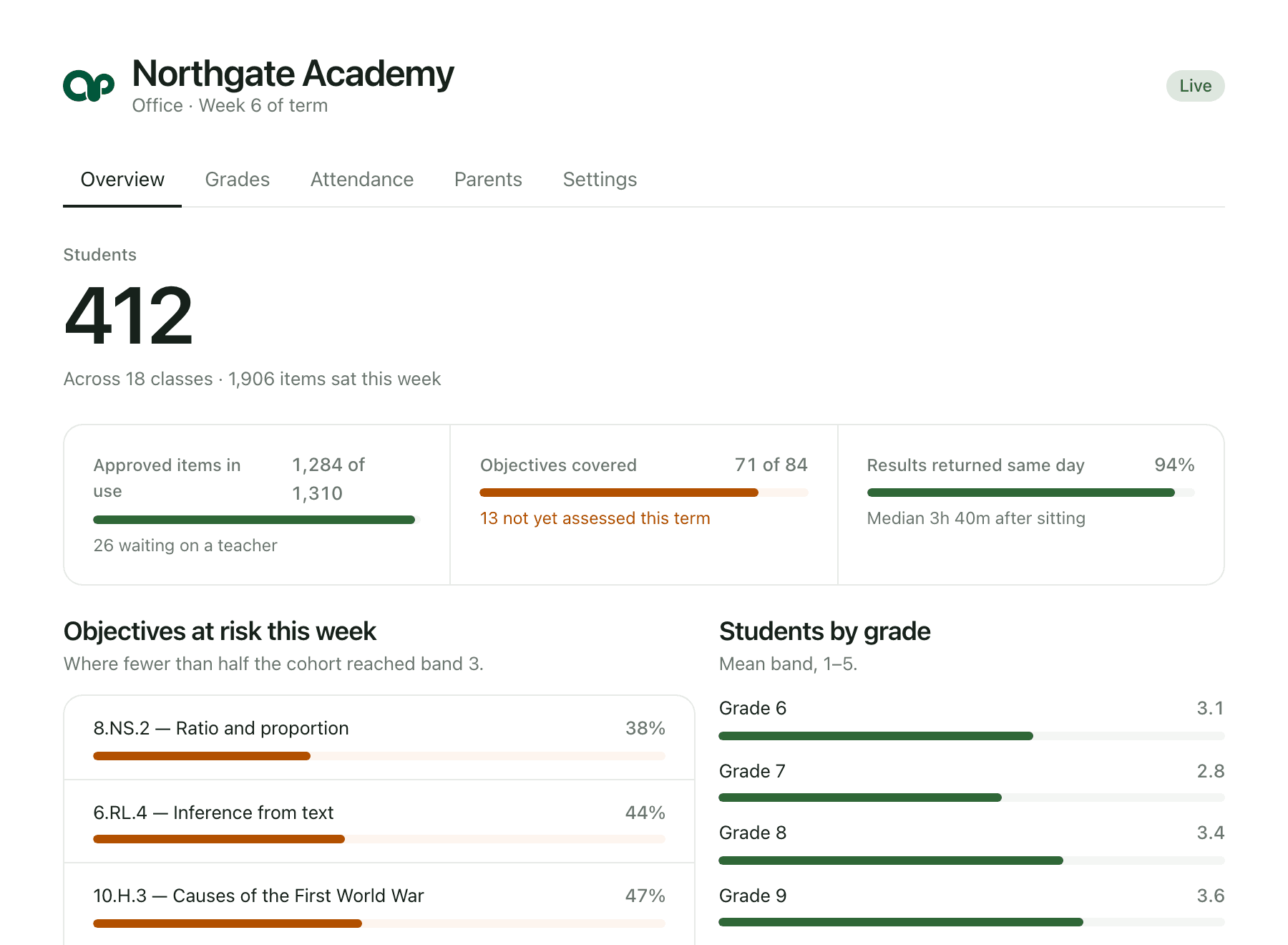
See the gap in week two.
Coverage, outcomes and turnaround across every class and subject, with the objectives at risk surfaced before the exam does it for you.
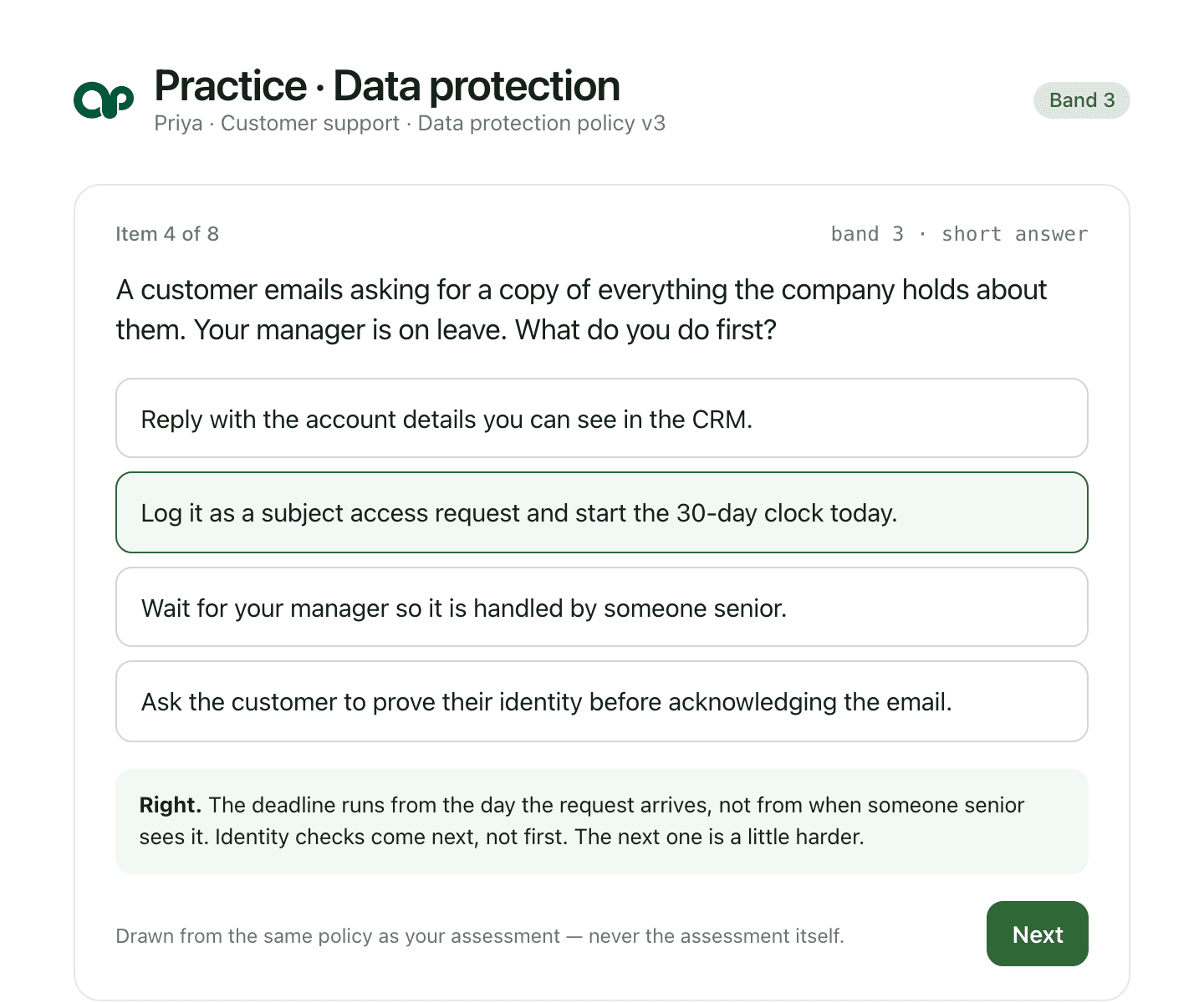
For the workforce
Practise the same material, on your own time.
Self-paced sets from the policy or course someone is actually enrolled in, with a worked answer for every item — and never the assessment itself.
One platform, opening two ways.
An institution has two kinds of people in it: the ones who decide what good work looks like, and the ones learning to do it. AptitudAI serves both from the same ingested coursework — teachers building assessments they trust, students practising against the very same material on their own time.
Shared foundation
Everything starts from your own material.
Chapters, syllabi, prior assignments, competency frameworks — ingested once. Both sides of the platform are generated from that same source, so what a teacher sets and what a student practises are the same subject, in the same language, held to the same standard.
For educators
Set the standard, then hold the work to it.
- Draft items straight from a chapter you already teach, across question types and difficulty bands
- Approve or reject each one — nothing reaches a learner unapproved
- The rubric is written alongside the questions, not invented afterwards
- Results by learner, cohort and objective, back in time to change the lesson
For students
Practise the same material, at your own pace.
- Self-paced sets drawn from the courses you are actually enrolled in
- Multiple choice, fill in the blank, short and long answer — every one with its worked answer
- Difficulty follows you: more of what you missed, less of what you have already shown
- No grade, no deadline, no record. Practice belongs to the student
Held on both sides
Practice and assessment are drawn from one generation ledger and never overlap. A learner can work through everything the platform will ever give them and still not have seen the exam — which is what makes it safe to open both doors onto the same coursework.
The engine, end to end.
Automated creation
Point the engine at a chapter, a syllabus or a competency framework and it drafts the items. Your faculty approve or reject each one; what survives becomes the bank.
Personalised at scale
Difficulty, phrasing and sequence shift with each learner's history. A cohort of ten thousand sits ten thousand tests, marked on one scale.
Complexity diagnosis
When a learner stalls, the engine narrows down which sub-skill is missing rather than reporting a low score and leaving you to guess.
Every question type
Multiple choice, fill in the blank, short answer and long answer — on laptop, tablet or phone.
Bias review
Items are checked for linguistic, cultural and contextual load before they reach a learner, and flagged for human review when the check is uncertain.
Real-time insight
Results land as they happen, by learner, by cohort and by objective — so a gap in week two is visible in week two.
Fits your stack
Runs on its own, or integrates with any existing LMS as the institution needs. API-first and multilingual by default.
Improves with use
Items that fail to separate strong learners from weak ones are retired automatically. The bank sharpens every term.
Four sectors, one engine, different questions.
Enterprise
Prove the training worked.
Compliance and upskilling programmes usually end at a completion certificate. AptitudAI measures what the workforce can do afterwards, by role and by competency framework, and keeps measuring as roles change.
What that looks likeGovernment
Measure a national programme, not just attendance.
Population-scale skilling needs evidence of learning, not headcount. The engine delivers and scores in the languages a programme actually runs in, and reports outcomes back at district and cohort level.
What that looks likeHigher education
Defensible evidence of learning.
Accreditation asks whether students met the stated outcomes. AptitudAI ties every item to a learning objective, so the answer is a report rather than an argument — and faculty stop losing evenings to writing question banks.
What that looks likeK-12
Find the gap in week two, not at the exam.
Formative assessment only helps if a teacher gets it back in time to change the lesson. The engine generates short, curriculum-aligned checks and returns them the same day, with practice a student can do on their own.
What that looks likeSix levels. One clear path forward.
Before you can assess learners, it helps to know where your own organisation stands. Our readiness framework places teams on a six-level scale using observed behaviour — what people actually do with AI, not what they say in a survey.
Explore the frameworkL6 · AI as the engine
Self-improving, memory-driven systems at scale. Capability compounds instead of plateauing.
Writing on assessment.
Policy
Beyond High-Stakes Testing: How AI Is Redefining Assessment for the Future of Learning
One exam at the end of the year decides a lot and explains very little. What replaces it when measurement can run continuously.
Platform
From Static Exams to Living Assessments: How AI Enables Real-Time Skill Intelligence
An assessment that updates as a learner changes tells you something a fixed paper never could.
Research
Learning Digital Twins: Modeling a Student's Cognitive Growth with AI
If you can model how a student's understanding moves, you can teach ahead of the gap instead of behind it.
The questions we get asked first.
Short answers. Anything longer is a conversation, and the demo is the quickest way to have it.
Does the AI write the questions, or do we?
The engine drafts them from your own coursework — a chapter, a syllabus, a competency framework. A teacher or faculty member approves or rejects every item before it can reach a learner. Nothing unapproved is ever delivered.
Who marks the work?
The engine grades every response against the rubric that was written with the question, including short and long answers. The teacher reviews and approves the grades before anything is released to a learner — the same person who approved the questions signs off on the marks.
If students can practise on the same material, can they see the exam?
No. Practice sets and assessments are drawn from one generation ledger and never overlap. A student can work through everything the practice track offers and still not have seen a single exam item.
What does 'adaptive' actually mean here?
Each answer decides the next item. Difficulty, phrasing and sequence shift with the learner's history, so a cohort of ten thousand sits ten thousand different tests — all marked on one scale, so results stay comparable.
Which question types are supported?
Multiple choice, fill in the blank, short answer and long answer, on laptop, tablet or phone. The rubric is written alongside the questions, not invented afterwards.
Does it work with our LMS?
It does not need one. AptitudAI is a complete assessment system with its own teacher, student and office views. Where an institution already runs Canvas, Moodle, Blackboard, Teams or anything else with an API, it integrates with that system as the institution needs, so grades and rosters stay in sync.
Who owns the student data?
Your institution is the controller. The deployment is isolated per client, encrypted in transit and at rest, with audit trails on every action. We never sell student data or use it to serve anyone else.
What happens in a demo?
It runs on your material, not ours. Send one module and you will see the items it drafts, the rubric beside them and the report it produces.
Bring us a chapter. We will show you the assessment it becomes.
A demo runs on your material, not ours. Send one module and see the items, the rubric and the report it produces.
Request a demo